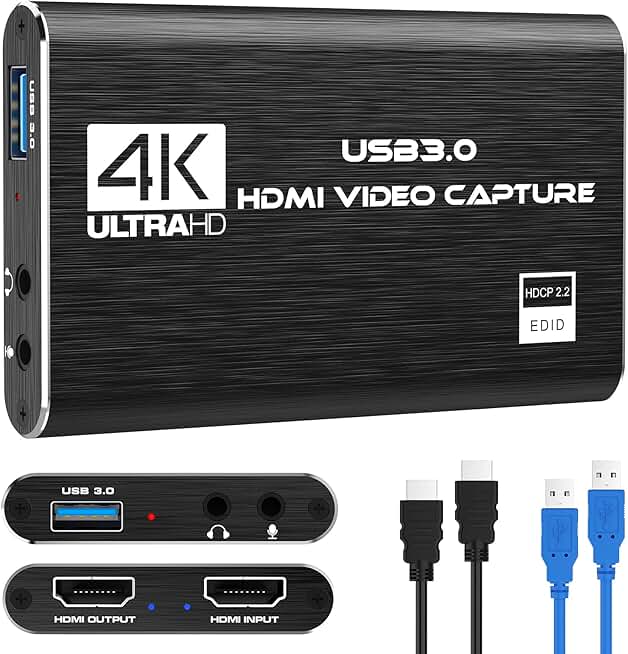
When shopping for a capture card for PC, you need to nail down a few key specs before dropping money. First, decide what resolution and frame rate you actually need. If you're streaming console games, 1080p60 is the industry standard and handles most Twitch/YouTube workflows fine. But if you own a PS5 or Xbox Series X, 4K60 capture with HDR10 support is worth the investment—it future-proofs your content and looks noticeably sharper on modern displays.
Next, check the connection type. External USB capture cards are plug-and-play and work with any PC, but they eat USB bandwidth. Internal PCIe cards (like the AVerMedia GC573) offer lower latency and don't compete for USB ports, but they require opening your case and only work on desktops. USB 3.0 is the minimum for 1080p60; USB 3.1 or Thunderbolt handles 4K without choking.
Passthrough is a huge quality-of-life feature. This lets you monitor your console on a separate display with near-zero latency while your PC records the clean feed. Not all budget cards support it, so check the specs if low-latency monitoring matters to you.
Driver stability is critical—a flaky driver will tank your stream. Elgato and AVerMedia have the best track records here. Also verify OBS compatibility before buying; most modern cards work fine, but older budget models sometimes have quirky plugin requirements.
Finally, consider your actual use case. Streaming at 1080p60? A $20 card works. Recording 4K60 HDR for YouTube? Spend the extra $100 for Elgato's 4K S or 4K X. The best capture card for PC is the one that matches your console, your PC's USB/PCIe capacity, and your streaming resolution.