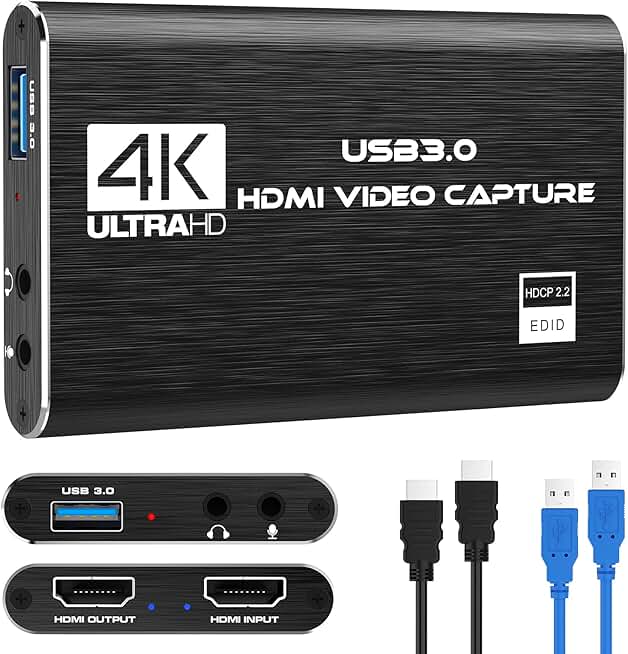
When shopping for a capture card for simulation games, focus on these key factors:
Resolution and Frame Rate: Sim racing and flight sims benefit from smooth motion. Look for at least 1080p60, but 1440p120 or 4K60 gives you flexibility if you upgrade your monitor or want to showcase high-refresh gameplay. Check the difference between capture resolution and passthrough resolution—passthrough is what you see on your monitor during gameplay, and lower latency there matters more than capture quality for live streaming.
Passthrough Latency: This is critical for sims. A capture card with HDMI loop-out lets you monitor your game on a separate display while capturing. Ultra-low latency (under 1ms) keeps your inputs responsive. Cards with HDMI 2.1 support are future-proof for high-refresh monitors.
Connection Type: USB 3.0 is the standard for external cards. USB-C is convenient but less common. Internal capture cards (PCIe) offer zero latency but require a desktop PC with available slots.
Compatibility: Most modern capture cards work with PS5, Xbox Series X/S, Nintendo Switch, and PC. Verify your specific console or setup before buying. Mac and iPad support varies—check the product specs if you stream from Apple devices.
Software and Drivers: OBS compatibility is essential. Some cards ship with proprietary software that's bloated or outdated. Simpler is better—plug-and-play cards save you troubleshooting time.
Price-to-Performance: Budget cards ($15–$30) handle 1080p60 well for sims. Mid-range ($60–$160) adds 4K passthrough and better build quality. Premium cards ($250+) target pros who need 4K144 or internal PCIe options.
Red flag: Avoid cards with no loop-out if you plan to stream live—you'll introduce input lag that ruins sim racing and flight sim precision.