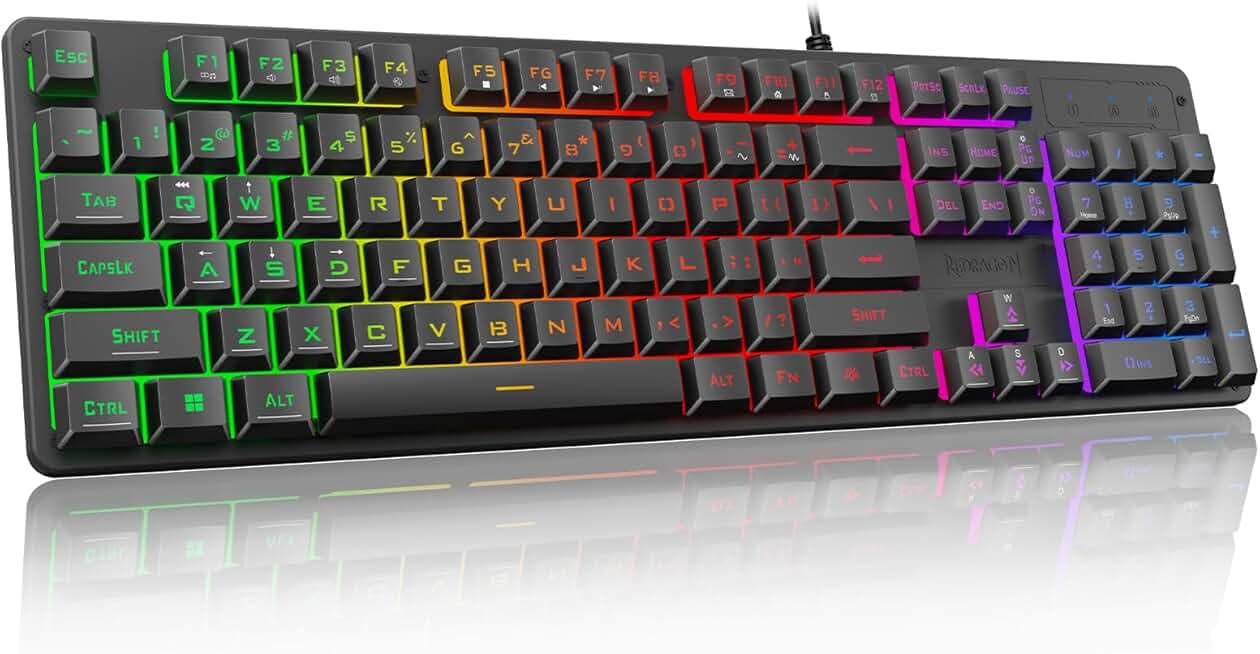
When shopping for your first gaming keyboard, focus on a few core specs that actually matter. Polling rate—measured in Hz—determines how often your keyboard reports keypresses to your PC. 1000Hz (1ms response time) is the standard for gaming; anything lower feels sluggish in fast-paced titles. Anti-ghosting prevents missed inputs when you press multiple keys simultaneously, essential for gaming but less critical for typing.
Switch type divides keyboards into two camps: mechanical and membrane. Mechanical switches have individual springs under each key, offering tactile feedback and faster actuation. Membrane switches use a rubber dome, feeling softer and quieter but requiring more force. For first-timers, both work fine—mechanical feels premium and lasts longer, but membrane is quieter and cheaper.
RGB lighting is purely aesthetic, but it's a nice morale boost when you're learning the ropes. Look for per-key or zone-based programmability if you want to customize profiles. Key travel distance (how far a key moves) typically ranges from 1.5mm to 4mm; shorter travel is faster, longer travel feels more deliberate.
Size matters too. Full-size keyboards (104 keys) give you the numpad and familiar layout. Compact 60-68% boards save desk space and improve ergonomics by bringing your mouse closer. As a first-timer, full-size is safer unless you're short on space.
Finally, check the cable length and material. Braided cables last longer than rubber, and 5-6 feet is standard. Avoid ultra-cheap keyboards with flimsy wiring—they fail fast. Budget $15-50 for a solid entry-level board; anything under $12 is a gamble on durability.
![Redragon Updated S107 Gaming Keyboard and Mouse, RGB Gaming Keyboard and 10000 DPI Mouse Combo with 25-Key Anti-Ghosting, 1K Hz Programmable Mice with Software, Plug & Play to PC, Laptop [Upgrade]](https://m.media-amazon.com/images/I/71aECRRv3vL._AC_UY654_QL65_.jpg)